Categories
Blog Blog 3 - Reflections Uncategorized

THE CONSTITUTION AS A LIBERATOR OF THE OPPRESSED

By Arvind Kumar

The Indian Constitution has completed 76 years of existence in 2025. It is an appropriate time to reflect and ask ourselves to what extent has the Constitution reached the Indian masses?

My own recollections and impressions developed in the course of my research and education in rural Uttar Pradesh suggest that the constitution has mass reach is viewed as a liberator from social and economic oppression by the marginalized. The installation of Dr. B. R. Ambedkar’s statues on public land in remote rural areas has given added visual presence to the constitution. The digitization of the constitution and the Constituent Assembly Debates has brought about a paradigm shift in rediscovering its meanings among scholars and citizens. The recent efforts of grassroots rights organizations such as the Jashn-e-Samvidhan yatras led by Mazdoor Kisan Shakti Sangathan (MKSS) activists in rural Rajasthan provide a model for increasing constitutional awareness among non-English-speaking rural populations in deprived areas.  

Discovering the historical memory of the Indian Constitution in my rural village

In the winter of 2016, upon my return to my rural village in eastern Uttar Pradesh from Delhi, where I worked as a university lecturer (Satyawati College, University of Delhi), I was asked an interesting question about the constitution by the oldest man of my village.  He asked, ‘What is the first line of the Indian Constitution?’ The person’s name was Ram Samujh. He had not only passed the 8th standard in the 1950s, a rare achievement in the village, but was also the topper in the whole block(an administrative unit for rural development comprising around a hundred villages). He thus enjoyed the highest respect in my village. His question struck me deeply, and instead of responding directly, I enquired why he was asking this question. He replied that he had been informed that I had become a professor of political science at the University of Delhi, to teach the Indian Constitution. Upon further asking, he told me that during the 1960s, when the villagers of Tikari and Jaitpur picked up the fight against the practice of bondage labour (begari pratha), sitting on a hunger strike in front of the UP Legislative Assembly (Vidhan Sabha) against the local landlord, who was also their local MLA, they had been told that the first line of the Indian constitution says that bondage labour is abolished [Samvidhan Ki Pahali Hi Line Me Likha Hai Ki Begari Samapt Kar Di Gayi Hai].

In the hierarchy-driven Indian society, what is written in the first line of the Constitution, a prestigious document, matters quite a lot for ordinary people. In the 1960s, very few if any of the village residents had read the constitution, or even seen it, yet the knowledge of the line abolishing bondage labour (begari pratha) had inspired them in their travel to the capital city Lucknow and their hunger strike in front of the UP Legislative Assembly (Vidhan Sabha) against their powerful local landlord of Tighara estate (currently located in the Jalalpur Tehsil of Amebedkar Nagar District, Uttar Pradesh). The landlord, Jagdamba Prasad, had won the Jalalpur assembly constituency in the 1967 Uttar Pradesh Assembly Election as an independent candidate and in the 1969 Assembly Election as the Congress party candidate.  The strike, in turn, led to the institution of a magisterial inquiry that eventually freed them from the practice of bonded labour, a traditional system of forced or compulsory labour without payment, a type of slavery. In the eastern and Awadh regions of Uttar Pradesh, workers from Dalit and Backward castes, such as Chamar, Nishad, and Pasi, were exploited through begari pratha. The Indian Constitution prohibited begar and other similar forms of forced labour under Article 23, but the practice had continued. The end of this exploitative system allowed members of these castes and communities freedom to choose their occupation and exercise their voting rights.

The question from my village elder had placed me in a dilemma: should I tell him the truth, after such a long time had passed since the event? I realised that my truth might harm him psychologically, as he might come to believe he had been fooled. Therefore, adopting a middle path, I told him that you are right that the constitution abolishes bonded labour, but instead of the first line, it is written on the first page of the constitution.,the Preamble of the Constitution which embodies the fundamental values of equality, liberty and social justice

Recollecting the social memory of the Constitution in Ambedkar statues and Awadhi Songs

My childhood memory goes back to 1993-94, and the announcement of the death of former president Gyani Jail Singh. During those days, Dalits in Awadh and Eastern Uttar Pradesh had started installing the statue of Dr. B. R. Ambedkar on public lands. They had evolved this strategy to counter the attempt of the upper castes to forcibly capture public lands by installing statues of gods and goddesses. The installation of Ambedkar’s statues with the constitution in his one hand forced the people to see the constitution. Not so different from Rousseau’smaxim that , ‘People should be forced to be free’, we could say Dalits forced people to see the constitution as the condition of their freedom. This might be one of the reasons why Ambedkar statues are so often desecrated.

The Constitution also lived in the memory of the rural masses in their folk songs. I can recall an incident of 1995 when the upper castes objected to a Bhimwadi song (Song on Ambedkar), which culminated in a near clash. The song praised Ambedkar for making the constitution, which had liberated the untouchables. It was titled ‘Baba Ho Samvidhanva Banaya Gaye, Jawan Achhutva Bhuiyan Bath Naa Pavain, Wahin Achhutavai Ko Kurshi Pe Baitha Gaye’ (My grandfather has made the constitution. Untouchables who were prohibited from sitting on the land have now been empowered to sit on the chair).

Different versions of the song are very popular and still sung in Awadh and Eastern Uttar Pradesh at marriage ceremonies of Dalit communities. The loud recitation of such songs praising the constitution and their public broadcasting through loudspeakers compels the people to know about the constitution.

The Constitution in the Urdu Public Sphere

The advocacy of the Indian Constitution in terms of its provision for minority rights through secularism, socialism, and democracy is also to be found in the Urdu public sphere. This can be seen in the nijamats of Anwar Jalalpuri in Urdu mushairas, recollecting memories of his grandfather. He had abandoned his plan to migrate to Pakistan during Partition after learning that the Indian constitution had provisions of secularism, socialism, and democracy to protect minorities. In the 1990s, the recitation of such stories became common in Urdu mushairas.     

Constitutional knowledge the aspirant Middle Class

There is a huge craze for government jobs in India. To apply for these, one needs to prepare for a competitive examination. While travelling in different cities of Uttar Pradesh around 2010, I found that two books on the constitution- Our Constitution by Subhash Kashyap and The Introduction to the Constitution of India by DD Basu were quite popular. The former was published by the Government of India publication, National Book Trust, and its copies were supplied cheaply to schools. It was a commentary on the Indian constitution, and I had an opportunity to read it in 2003 when I was in the 7th class. Basu’s book presented the bare text of the Constitution, accompanied by judicial interpretations.  These were the books that shaped the knowledge about the Constitution of a large number of students aspiring for jobs in government service. The period after -2010 saw the growing popularity of M. Laxmikant’s Indian Polity. Granville Austin’s Indian Constitution- The Cornerstone of the Nation stands apart, but it was still referred to as an academic text.  

Digitalisation and Rediscovering the Meaning of the Constitution

While the Constitution of India has become popular among the middle classes, its understandings have been largely shaped by judicial interpretations of the articles. Today, however, digitalisation projects such as the ConstitutionofIndia.Net have brought a paradigm shift in the recovery of the meanings of the constitution by students and ordinary citizens. Each article of the Constitution is linked to the corresponding debates in the Constituent Assembly, which helps us understand how different versions of each article evolved. This is now becoming a popular method to understand the meanings of the articles of the Constitution, rather than through judicial interpretations alone. Digitization projects such as constitutionofindia.net and PACT have the potential to make the Constitution into a subject of mass understanding and engagement, rather than an elite project limited to judicial interpretation.

Samvidhan Yatra: The Constitution on the Move

The Mazdoor Kishan Shakti Sangathan (MKSS), which has played a very significant role in the enactment of the Right to Information Act (RTI) and the National Rural Employment Guarantee Act (NREGA), took a very significant step to spread awareness about constitutional values through organising Samvidhan Yatras. Between November 26 and  January 26,the Yatra covered over 50 villages of central Rajasthan: Thana, Barar, Jawaja, and Chhapli in three phases, establishing at its conclusion Samvidhan Kendra, a library, study centre, and a place to address grievances. Samvidhan Yatras provide a model for celebrating the Constitution in rural non-English speaking areas, not as a  icon to be worshiped, but as a document of people’s rights, justice, and empowerment, that can serve the promotion of participatory democracy and enable structural changes at the grassroots level.

In summing up, although the Indian constitution was drafted by indirectly elected elites and representatives of princely states, its liberatory potential has made it a public document. It has been reaching the masses since its inception and no longer remains an elite document.

Dr. Kumar is an Associate Fellow at the Institute of Commonwealth Studies, University of London, and a Visiting Lecturer in Political Sociology, University of Hertfordshire, United Kingdom.

Categories
Blog Blog 3 - Reflections

Reflection: The Future and the Past: Reflecting on the Supreme Court’s Reliance on History in Decision Making

by Aishwarya Birla, NLSIU

Introduction

As the Supreme Court of India marked its 75th anniversary this year and journeys into its 76th year, it is fitting to examine how constitutional history continues to shape and inform contemporary jurisprudence. The Court, which replaced the colonial Federal Court of India and the Judicial Committee of the Privy Council in 1950, has consistently demonstrated the relevance of historical context in constitutional interpretation. This article analyzes three landmark judgments from 2024 that significantly relied on constitutional history to address complex legal questions concerning citizenship, parliamentary privileges, and affirmative action. These landmark judgments of 2024 demonstrate the Supreme Court’s commitment to grounding contemporary constitutional interpretation in historical context, anapproach which continues to provide crucial insights for addressing modern constitutional challenges. .

The Citizenship Question: Section 6A of the Citizenship Act 1955

The Supreme Court’s examination of the National Register of Citizens (NRC) and Section 6A of the Citizenship Act represented a crucial intersection of constitutional history and contemporary challenges. The case, decided in October 2024, centered on the validity of provisions affecting citizenship in Assam, particularly concerning immigrants from Bangladesh after March 24, 1971.

The constitutional bench’s 4:1 majority judgment upholding Section 6A’s constitutionality demonstrated the enduring relevance of the Constituent Assembly’s deliberations on citizenship. The Court emphasized the historical context’s significance, noting that citizenship questions in India are inextricably linked to Partition history. As the majority opinion observed:

“Prior to examining the contentions articulated by the parties on the constitutionality of the provision and engaging in a discussion on the various legal issues involved, it is imperative to trace the history of this matter and have a holistic understanding of how the provision, Section 6A, came into being.”

The complexity of citizenship provisions was evident in Dr. BR Ambedkar’s candid admission during the Constituent Assembly Debates (August 10, 1949):

“Except one other Article in the Draft Constitution, I do not think that any other article has given the Drafting Committee such a headache as this particular article. I do not know how many drafts were prepared and how many were destroyed as being inadequate to cover all the cases which it was thought necessary and desirable to cover.”

Parliamentary Privileges: Sita Soren v Union of India

The March 2024 judgment in Sita Soren v Union of India marked a significant reinterpretation of parliamentary privileges and immunity. The seven-judge bench unanimously overruled the P.V. Narasimha Rao decision, establishing that Articles 105(2) and 194(2) do not protect acts of bribery under parliamentary immunity.

In reaching this conclusion the court undertook a detailed analysis of the history of parliamentary privileges (Part E). This inquiry began with the Government of India Act 1833, where legislatures had special facilities, including providing complete information on the subject of the legislation, the right to be present in all meetings of the Council of the Governor-General, freedom of speech, and freedom of voting. The evolution of parliamentary privileges, with this starting point, was traced through the Charter Act of 1853, the Indian Council Act of 1861, and the Government of India Acts of 1909, 1919, and 1935. Beyond these legislations, references were also made to the Reforms Committee of 1924, which suggested that certain additional privileges be granted to Indian Legislatures. The committee further recommended introducing a penal provision for influencing votes within the legislature through inter alia bribery. This resulted in the government introducing the Legislative Bodies Corrupt Practices Bill, which although ultimately lapsed, proposed to penalise (i) the offering of bribe to a member of a legislature in connection with his functions; and (ii) the receipt on demand by a member of the legislature of a bribe in connection with his functions.

The privileges across these acts were said to not be a blanket immunity from criminal law. Despite colonial resistance, the demand for parliamentary privileges in India was consistently linked to their relevance to the responsibilities Indian legislators aimed to fulfill. (para 59). It was this pre constitutional background that was said to inform the vision of the Constituent Assembly pertaining to Articles 105 and 194 of the Constitution.

Affirmative Action: State of Punjab v Davinder Singh

In August 2024, the Supreme Court addressed the complex issue of sub-classification within Scheduled Caste categories. The seven-judge bench’s 6:1 majority decision drew heavily on historical sources to understand the heterogeneity within Scheduled Castes. Both the majority opinion and the dissenting opinion relied on the Constituent Assembly Debates to analyse Article 341 of the Constitution – Scheduled Castes. Draft Article 300A (corresponding to Article 341 of the Constitution of India, 1950) was not included in the Draft Constitution of 1948. It was introduced by the Chairman of the Drafting Committee on 17 September 1949. This provision authorized the President to identify and designate castes, races, or tribes as ‘Scheduled Castes’ through a public notification, following consultation with the Governor of a State. Additionally, it granted Parliament the authority to modify the President’s notification by including or excluding any caste, race, or tribe through legislation.

The Court’s analysis referenced Dr. B.R. Ambedkar’s explanation in the Constituent Assembly regarding Article 341:

“The only limitation that has been imposed is this: that once a notification has been issued by the President… thereafter, if any elimination was to be made from the list so notified or any addition was to be made, that must be made by Parliament and not by the President. The object is to eliminate any kind of political factors having a play in the matter of the disturbance in the Schedule so published by the President.”

Beyond references to constitutional history, the decision of the court also undertook a historical analysis to gather evidence of backwardness within the Scheduled Castes. This historical injustice of untouchability was a major factor considered in arriving at the outcome of the case. The historical material used to analyse heterogeneity and intelligible differentia began with the definition of depressed classes as raised in 1916 in the Legislative Council, and surveyed developments in the 1919 Southborough Franchise Committee, the 1931 Hutton Census Report, Report of the Indian Franchise Committee (1932) Vol I, the Minutes of dissent by Mr SB Rambe, Mr CY Chintamani, Mr RR Bakhale, Report of the Franchise Committee, the Government of India (Scheduled Castes) Order 1936, and the Constitution (Scheduled Castes) Order 1950.

Conclusion

These landmark judgments of 2024 illustrate the enduring relevance of constitutional history in contemporary judicial decision-making. The Court’s deep engagement with historical materials – from Constituent Assembly Debates to colonial legislation – is crucial for illuminating present-day constitutional challenges. Each case examined here dealt with fundamental aspects of Indian democracy: citizenship rights in an era of migration, the boundaries of parliamentary privilege in face of corruption, and the evolving interpretation of affirmative action policies. The historical analysis employed in these judgments serves multiple purposes. It provides a context for understanding the constitutional provisions, helps trace the evolution of legal principles through time, and ensures that contemporary interpretations link to the Constitution’s fundamental principles while adapting to modern challenges.

Categories
Blog Blog 2 - Forgotten Histories of Constitution-making

Ambedkar’s Forgotten Blueprint: Revisiting the 1930 Scheme of Political Safeguards

by Vineeth Krishna, CLPR

On Dr. B.R. Ambedkar’s birth anniversary, we reflect on his critical role in shaping modern India’s constitutional vision. Among his many contributions, the 1930 A Scheme of Political Safeguards for the Protection of the Depressed Classes, co-authored with Rao Bahadur R. Srinivasan and submitted at the First Round Table Conference, deserves far more recognition than it typically receives. This document laid out a strikingly forward-thinking framework for Dalit rights and continues to resonate in contemporary debates around caste, representation, and equality.

The Scheme outlined eight key provisions (‘conditions’) aimed at ensuring the political and social empowerment of the Dalit community. These were not parsed as abstract ideals but aimed building specific legal and institutional safeguards designed to correct centuries of structural marginalisation. Central to the proposal was the demand that the Dalit community be treated as a distinct political entity with guaranteed rights, rather than as a social category passively assimilated into the nationalist project.

The scheme opens with striking clarity and force, setting the tone for what follows:

“The Depressed Classes cannot consent to subject themselves to majority rule in their present state of hereditary bondsmen… The Depressed Classes must be made free citizens entitled to all the rights of citizenship in common with other citizens of the State.”

What follows, then, is a legal provision effectively calling for the abolition of untouchability and the full recognition of members of the Dalit community as equal citizens. This anticipates Article 17 of the Constitution and stands as one of the earliest efforts to link Indian social reform to enforceable legal and constitutional norms in the context of Dalit rights. The scheme makes clear that legal equality alone is insufficient unless supported by affirmative duties on the part of the state—an argument that continues to be central to contemporary constitutional jurisprudence.

Another major concern addressed in the scheme is the practice of social and economic boycotts. The scheme proposed that these forms of coercion be explicitly criminalised, even detailing specific acts that should attract penal sanctions. This foresight anticipates later legislative interventions such as the Protection of Civil Rights Act (1955) and the Scheduled Castes and Scheduled Tribes (Prevention of Atrocities) Act (1989). Ambedkar and Srinivasan demonstrate a clear understanding that social exclusion operates not only through overt discrimination but also through informal economic and cultural sanctions. A similar provision was later included in States and Minorities 1947, submitted to the Constituent Assembly, but it too was excluded from the final Constitution—though statutory provisions would eventually address the issue. Ambedkar’s recognition of the widespread nature of this practice was remarkably prescient; even today, social and economic boycotts remain a powerful tool of oppression against marginalised communities. He was among the earliest thinkers to argue that such practices should be explicitly named and tackled through constitutional provisions and the force of law.

In one of its most historically controversial yet crucial provisions, the scheme calls for separate electorates for the Depressed Classes—a demand that would shape much of Ambedkar’s constitutional efforts in the decades to follow. He viewed it as a necessary safeguard to secure genuine political representation, particularly given the entrenched dominance of upper-caste interests in existing political institutions. The demand sparked intense debate, culminating in the Poona Pact of 1932, but its underlying logic remains relevant: without independent political agency, formal inclusion risks becoming mere tokenism.

The scheme called for proportional representation in legislatures, cabinets, and public services. What is noteworthy is the insistence on not only representation but adequate representation—emphasising both quality and quantity. This emphasis prefigures the later policy of reservations, but with a broader focus on structural access to power, not just numerical quotas.

The scheme is also remarkable for its engagement with comparative legal frameworks. It references American civil rights legislation and Burmese laws against social boycotts, showing that Ambedkar and Srinivasan were thinking beyond India’s immediate context. Their approach positions Dalit rights within a broader international discourse on minority protection and democratic equality. In doing so, the scheme not only asserts a claim to justice within India but also aligns that claim with global constitutional developments.

Despite its clarity and foresight, the scheme has remained largely marginal in mainstream constitutional history. This is likely because later documents like States and Minorities received more attention and overshadowed it. Nevertheless, the legal and political vision articulated in the scheme has been quietly absorbed into key features of India’s constitutional framework. Articles 15 and 17, along with the broader system of affirmative action, all bear the imprint of principles first articulated in this early document.

Revisiting the scheme today is not merely a historical exercise. Many of the conditions it addresses—social exclusion, underrepresentation, and legal impunity—persist in different forms. The document reminds us that equality requires more than declarations: it must be structured into the political, legal, and institutional foundations of the state.

In sum, A Scheme of Political Safeguards is one of the earliest and most comprehensive articulations of Dalit constitutionalism. It demonstrates the far-sightedness of Dr Ambedkar’s legal imagination well before the drafting of the Constitution. His insistence on enforceable rights, robust representation, and institutional accountability outline a vision for a radically inclusive democracy. As we mark Dr Ambedkar’s birth anniversary, this scheme invites us to see constitutional democracy not as a finished project but as a continuous struggle—one rooted in the demands first made by those most excluded from power.

In that spirit, this moment offers an opportunity to think more expansively about Indian constitution-making itself—not as a one-time event, but as a living, evolving process and an ongoing conversation across time. This is the central premise  of the PACT project which will host a conference on the theme of Indian Constitution-Making as Ongoing Conversation. More information on the project and the conference call for abstracts is available here.  

Categories
Blog Blog 3 - Reflections

Reflection: Museumising the Indian Constitution

by Manas Raturi

In recent years, the Indian Constitution has become both a site of contestation between various political parties and a symbol of civil resistance against the state. Prior to 2019, the Indian Constitution remained relatively obscure in public discourse, despite shaping everyday life in fundamental ways. However, the widespread public protests against the Citizenship (Amendment) Act, 2019 brought the Indian Constitution to the forefront of public and media conversations.[1] For Arvind Elangovan, these developments highlight the significance of the Indian constitution in its political articulation – a process which invites an understanding of the text that extends beyond a purely legal and normative interpretation.

A recent development in this process of political articulation is the museumisation of the Indian constitution. Lately, we have seen a proliferation of several exhibitions, galleries and museums that have come up to showcase the Indian constitution as a cultural artifact of national heritage. Several initiatives illustrate this trend. In August 2021, the Ministry of Information & Broadcasting, as part of the ‘Azadi Ka Amrit Mahotsav’ programme, launched a series of e-photo exhibitions, including one on the making of the Indian Constitution. In 2022, the new Pradhanmantri Sangrahalaya was opened to the public as part of the newly reconstituted Prime Ministers’ Museum and Library (PMML, earlier the Nehru Memorial Museum & Library, the NMML) with its ground floor reserved for a ‘Constitution Gallery.’ In November 2024, a Constitution Museum was inaugurated at the O.P. Jindal Global University by the Union Law Minister and Lok Sabha Speaker. Recently, a ‘Constitution Gallery’ was inaugurated at the Maha Kumbh mela – one of the most significant Hindu pilgrimage festivals – by the Uttar Pradesh government’s Parliamentary Affairs Minister.

The display of the Indian Constitution in curated spaces raises important questions. In the context of representation of tribals in post-colonial India, Neela Karnik reminded us that museums also shape “knowledge by constructing material things as objects and ordering these in taxonomies – of the ‘rational’ or the ‘truthful’.”[2] One might then ask: what frameworks does the state deploy in the exhibition of the Indian constitution in dedicated sites of public display?

A visit to the Constitution Gallery in the PMML serves as a good starting point. The gallery is situated in the historic Teen Murti Bhawan in Lutyens’ Delhi. Designed by British architect Robert Tor Russell, the Teen Murti Bhawan was originally built in 1930 as the Flagstaff House for the Commander-in-Chief of the British forces in South Asia and later became the residence of India’s first Prime Minister, Jawaharlal Nehru. After Nehru’s death in 1964, the complex was converted into a library and a museum – the NMML. In 2018, the government announced its plan to reconstitute it into the Prime Minister’s M…L and to expand its focus beyond Nehru to incorporate the legacy of all former Prime Ministers. When the new museum was opened up, it contained a ‘Constitution Gallery’ dedicated to the making of the Indian constitution.

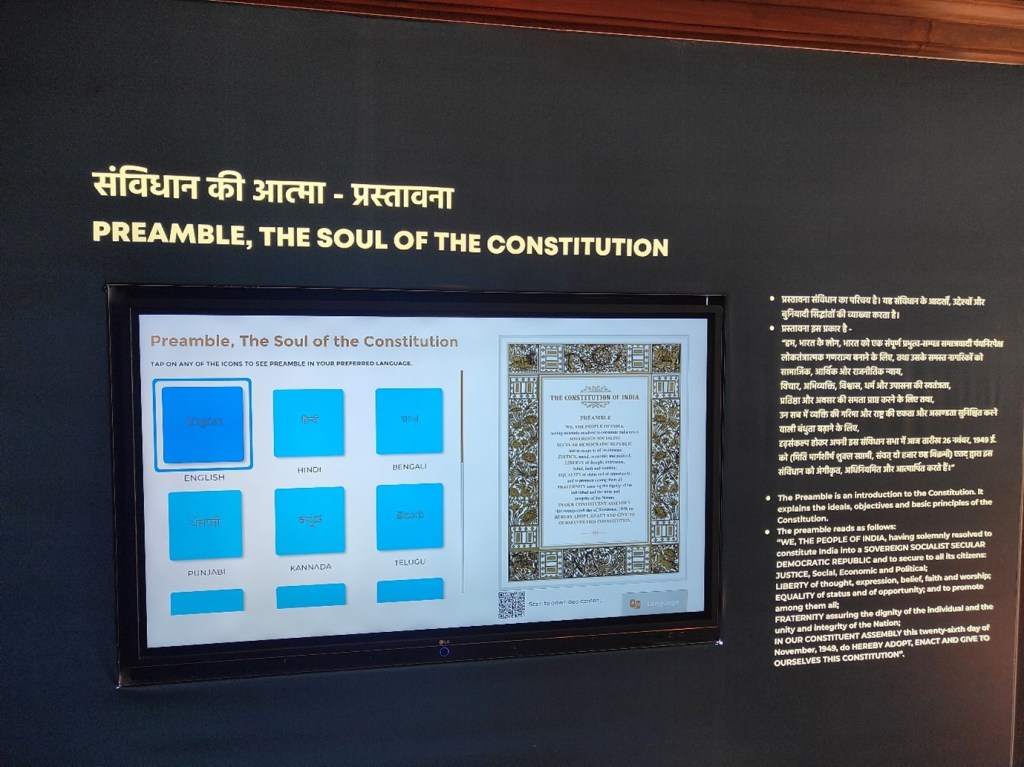
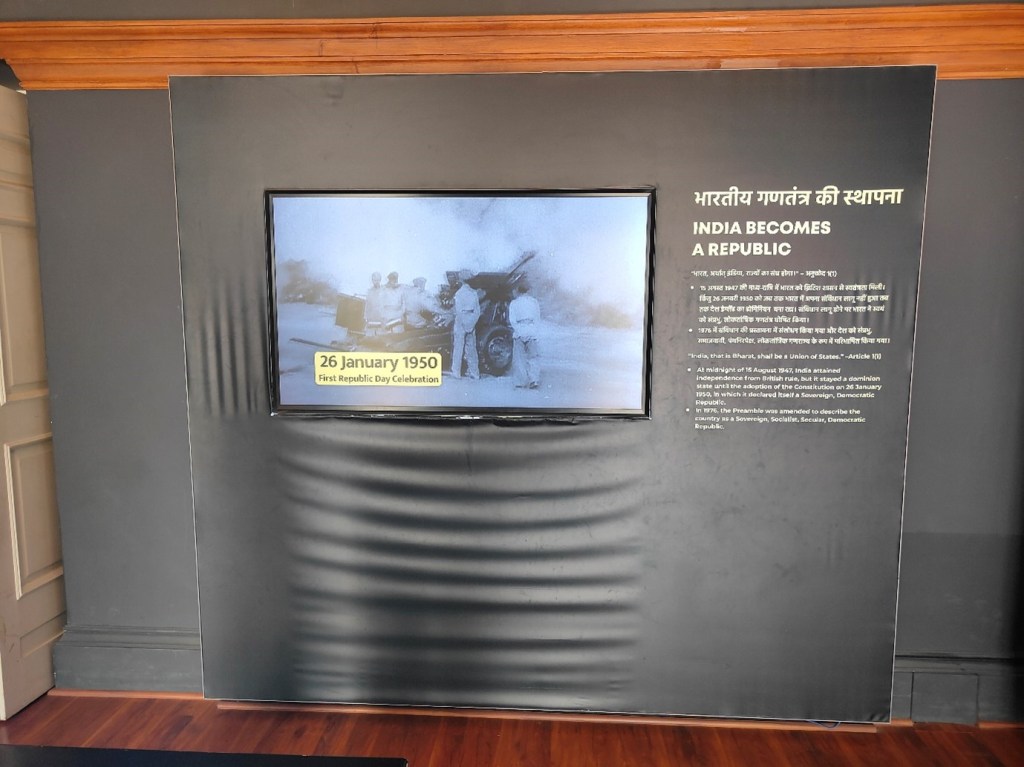
In its own words, the gallery intends to offer an ‘experiential’ view of the Indian constitution. Spread across different rooms, the gallery contains exhibits showcasing the Preamble of the Indian Constitution in multiple languages, alongside pictures and videos from the first Republic Day parade on 26 January 1950.

The Preamble in multiple languages (Source: clicked by author at the PMML)

Footage from the first Republic Day celebrations (Source: clicked by author at the PMML)

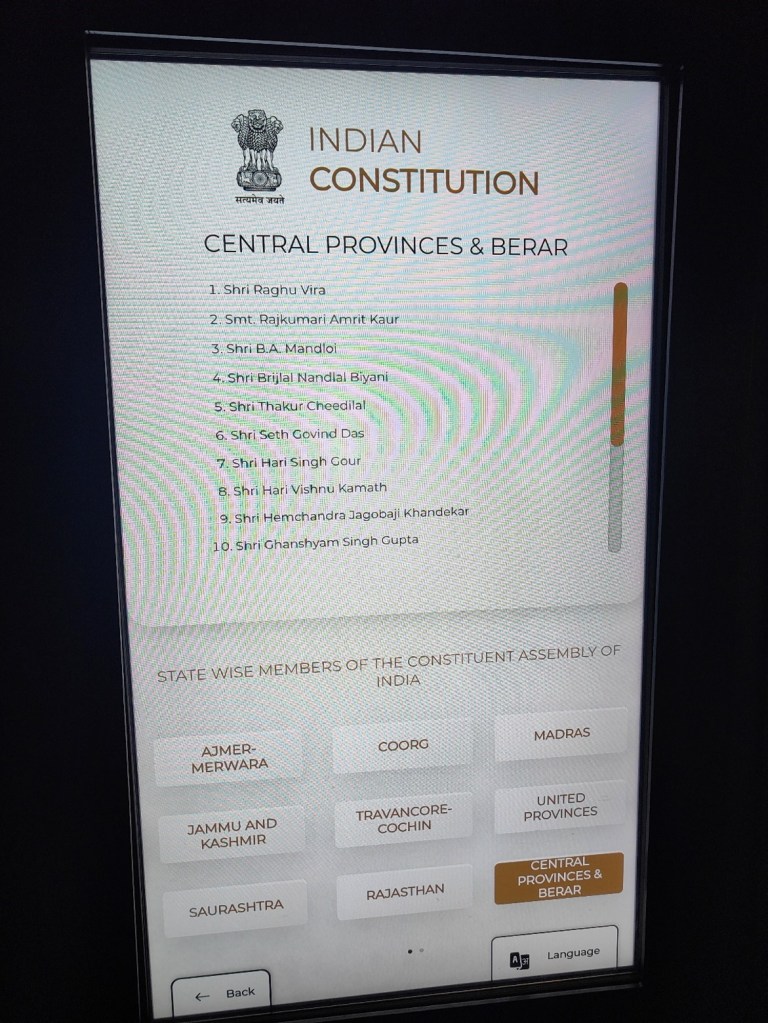
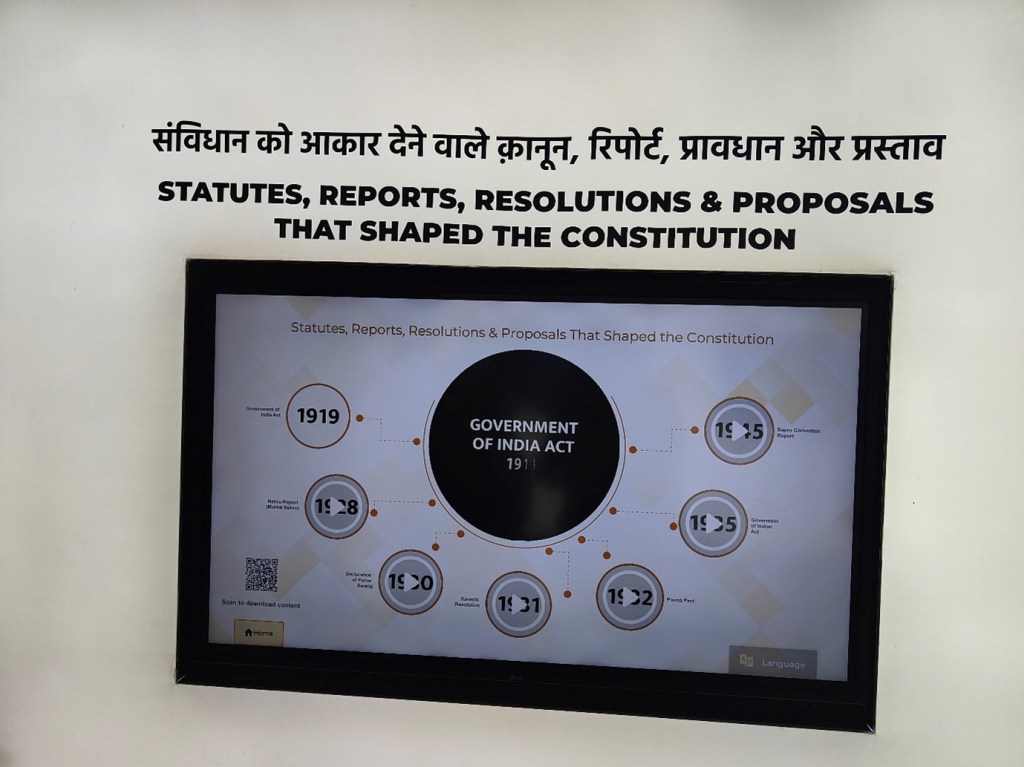
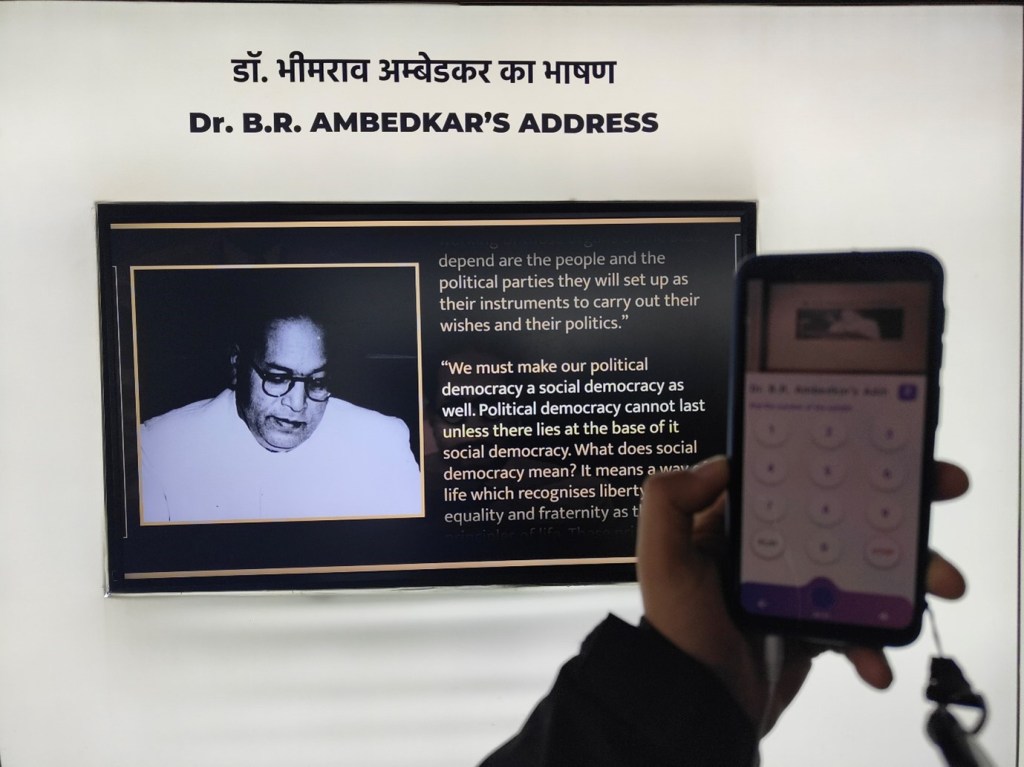
Visitors can view a digital display with the first edition of the Indian Constitution and explore its key features, such as the separation of powers or directive principles of state policy. Interactive screens provide a comprehensive list of Constituent Assembly members, their constituencies, and the various committees and subcommittees. A detailed timeline traces the significant statutes, reports, resolutions, and proposals that led to the formation of the Constituent Assembly, beginning with the Government of India Act of 1919 and to the 1945 Sapru Committee Report. It also highlights pivotal moments, such as Dr. B.R. Ambedkar’s address to the Constituent Assembly on 25 November 1949 and the first general elections in 1951. Additionally, a dedicated room focuses on the 105 amendments to the Indian Constitution up to 2021. These displays are accompanied with a physical audio guide the visitor can get to hear audio recordings playing in each of the rooms.

Details about the first edition of the Indian Constitution (Source: clicked by author at the PMML)

List of members of the Constituent Assembly of India and the constituencies they were elected from (Source: clicked by author at the PMML)

Details of different legislative reforms, reports and proposals that culminated into the making of the Constituent Assembly of India (Source: clicked by author at the PMML)

A room dedicated to some of the most significant constitutional amendments (Source: clicked by author at the PMML)

Dr. B.R. Ambedkar’s last speech in the Constituent Assembly of India and the audio guide (Source: clicked by author at the PMML)

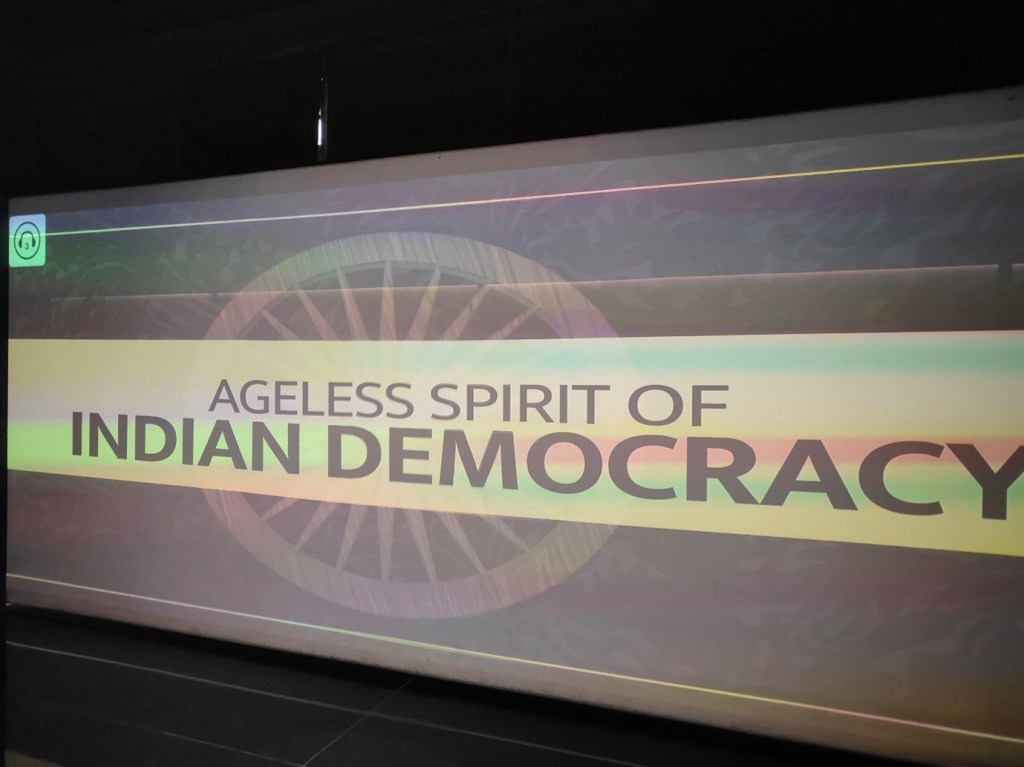
What merits attention are the different films being played in these rooms through which the Indian Constitution is portrayed as direct result of a seemingly continuous political tradition of democracy in India. The colonial rule is portrayed as a major disruption in an otherwise seamless history of democratic governance in the Indian subcontinent. Before the colonial presence, the pillars of democracy were firmly entrenched in this part of the world, the gallery tells us. In a room dedicated to ‘Makers of the Indian Constitution,’ for instance, a film shows a montage of images and videos to highlight the ‘ageless spirit of Indian democracy.’ The idea is to underline India as a historical site for deliberative assembly and popular participation through highlighting references from the Rig Veda and the presence of gana sanghas like that of the Shakyas and Licchavis.

A film that showcases how the roots of democracy were firmly entrenched in ancient India (Source: clicked by author at the PMML)

Whether these governing bodies and councils were indeed democratic or more aristocratic and oligarchic has been a point of scrutiny in scholarship.[3] Nevertheless, the description of Indian democracy as a historically continuous trend aligns neatly with the current representations of India in government discourse as a ‘mother of democracy’.[4] Through its ‘experiential’ setup, the gallery tells us that prior to colonial rule, the Indian subcontinent saw a flourishing tradition of freedom of religion, culture, art, linguistics and diverse belief systems. By framing the story of the Indian Constitution thus, the gallery links modern constitutional ideals with an ancient tradition of democracy in India. It suggests to visitors that the foundational principles of the Indian Constitution were deeply rooted in India’s ancient history.

It is important to remember that the Indian constitution emerged not only from a struggle against foreign colonial rule, but also from a confrontation with an internal feudal social order. The final text was far from a harmonious culmination representing continuity with ancient traditions. Rather it was the outcome of a series of contesting social struggles and political negotiations among widely contrasting groups – both within and outside the Constituent Assembly – regarding the future of the Indian society as a modern polity. In the process of its museumisation and elevation into a cultural artefact, we need to recall the Indian Constitution’s complicated history of a struggle against both external colonial forces and internal systems of oppression.

When the PMML was reopened in 2022, it garnered much debate on the possible revisionist tendencies to dilute the legacy of Nehru. But what perhaps deserves greater attention is this political articulation of the Indian Constitution through a narrative of seamless continuity between ancient democratic traditions and modern constitutional ideals. The Indian Constitution may not best be served by being portrayed as the inheritor of an unbroken civilisational legacy with its authority rooted in a mythologised past.


[1] Arvind Elangovan, ‘A political turn? New developments in Indian constitutional histories,’ in History Compass, Vol. 20, no. 8 (2022), e12746 [https://doi.org/10.1111/hic3.12746].

[2] Neela Karnik, ‘Museumising the tribal: Why tribe‐things make me cry,’ in South Asia, Vol. 21, no. 1 (1998), 275-288 [https://doi.org/10.1080/00856409808723337].

[3] See Romila Thapar, Early India: From the Origins to AD 1300 (Berkeley and Los Angeles: University of California Press, 2004), p. 147 and Eric W. Robinson, The First Democracies: Early Popular Government Outside Athens (Stuttgart: Franz Steiner Verlag, 1997), p. 23.

[4] See Suhasini Haidar, ‘India is indeed the mother of democracy, says PM Modi citing Mahabharata and Vedas,’ The Hindu (29 Mar. 2023) [https://www.thehindu.com/news/national/india-mother-of-democracy-home-to-idea-of-elected-leaders-much-before-rest-of-world-pm-modi/article66675267.ece]

Categories
Blog Blog 3 - Reflections

Reflection: Legalizing the Revolution: India & the Constitution of the Postcolony

by Rouf Dar

Can the Revolution be Legalized? Or, Can the Constitution be Decolonial?

The anticolonial revolution was legalized in the postcolonial constitution; at least an attempt was made, by the Congress which spearheaded both the processes. Sandipto Dasgupta makes this very compelling argument based on an in-depth analysis of the constitutive components of these processes. This book reads decolonization and constitutionalism as processes rather than mere events. It unpacks the processes, understanding intricately the elements of what successful decolonization and transformational constitutionalism entails. Both these processes are studied conjointly, and are synthesized in a book that is first of its kind in studies on the Indian Constitution.

The book appears to be interspersed with binaries. Anticolonial vs postcolonial, demos vs ethnos, street politics vs administrative politics, singularity vs multiplicity of imaginations. The important binary that forms the core of the book though, is the anticolonial and postcolonial version of the Congress party. Shifting from a mass politics-based party prior to independence, the Congress mutated into a governmental party that sought to institutionalize the gains of the decolonial moment. This metamorphosis was intentional, the book argues, and the primary reason for it became the fear of the disruptive and revolutionary energies of the masses. The same energies that successfully drove the British out, and unveiled the perversion of British liberalism embedded in the colonial empire, became a source of anxiety in the postcolonial founding. Apparently therefore, the postcolonial state-making project was dominated by the need of unity, and a consequent unitary state, which trampled over the multiplicities of imaginations that the masses possessed.

The need for postcolonial unity leads to the important question of federalism. As recent scholarship has shown, colonial India and the anticolonial movement was replete with diverse conceptions about the postcolonial organization of political power. This was in consideration of the humongous diversities that made up the Indian subcontinent, and the postcolonial Indian state too. The unitarian tendencies trampled these conceptions, with rare exceptions, and disallowed their institutionalization in the postcolonial polity.

What interests me here is the notions of federalism in African colonies. Scholarship points out to the use of federalism as an anticolonial philosophy wherein as many rights were squeezed from the colonial empire as possible, all the while thinking and contemplating about postcolonial imaginaries beyond the predominant nation-state system. Federalism could also be thought of a viable design to institutionalize the social diversity made ever so salient by the colonial empire. In India, instead of respectfully accommodating an inherently diverse set of peoples, federalism became merely an expedient strategy to integrate, assimilate, and manufacture a homogenous nation. The integration of princely states, which is touted to be a glorious feather in the cap of the Indian state-making project, is enough a testimony to the erasure of diversities in postcolonial India.

One could then ask, did the formation of a homogenous nation-state overpower the possibilities that decolonization was pregnant with? Further, at a more abstract level, is constitutionalism, which was transported to the whole world through the gun, the ship, and the pen, incapacitated as a framework to fully realise the revolutionary potential of masses and the multiplicity of political conceptions in the postcolonies?

Continuing with this, Sandipto argues that the constitutional project was not able to capture the imaginations of the masses. One of the outcomes of this failure was the communal violence leading up to Partition which, he argues, was due to this failed realization of the self-instituting and self-determining powers of the anticolonial movement. But what forms would that realization take? And would those forms be tenable in the expedient need for postcolonial unity? In other words, how would the possibly divisive conceptions be reconciled in the formation of the postcolonial state?

As we know, there have been multiple narratives explaining the politics of the Muslim League culminating in the demand for Pakistan. Did Congress’ conflict with Muslim League on this issue symbolize what would the mass politics would look like? If so, and if we are to accept the argument that Pakistan was the result of the exercise of a political agency, the travails and travesties of that political process point out that divisive conceptions in the formation of postcolony were sought to be suppressed from an early stage. Ambedkar’s own political trajectory in lieu of the marginalized castes is yet another case in point. Both these cases show that the Congress prioritized national unity over the expression of political diversity. In the light of this, can we then say that it was prudent from the Congress to be skeptical of the disruptive tendencies of the mass-based revolution?

This book shows that the use of repressive measures in postcolonial India had its seeds sown long earlier in 1937, when the Congress provincial regimes in Madras and Bombay used censorship and sedition laws to suppress dissent. Post-independence, it was to deal with the Communists who became a sort of the new “other” (the remnant Indian Muslims were already subdued by the horrors of Partition) against whom the repressive laws were incorporated. On the one hand, while the constitution envisioned a systemic and controlled transformation of the society, on the other hand, the repressive clauses were added into the same constitution to ensure unity, and homogeneity, of the postcolonial Indian state. Again, as we can see, the logic of a unitary state trampled over the rights of the individual and groups, and Congress was there to oversee the whole process.

The question of religious minorities, especially Muslims, after Partition emerged in a number of ways. They were marginalized in the constitution-making debates, their voices were stifled at times, and liberal-secular arguments were used at times to eventually rid them of the political safeguards that were afforded to other minorities. In such a context, what does the Congress’ historical familiarity with using repression do to the expedient use of “legitimating vocabulary” to deny political safeguards to Muslims?

In other words, the book hints at a supplementary, even if somewhat different, explanation of this problem compared to the existing scholarship, by focusing on the Communists. One can infer that Muslims were denied political safeguards not only because national unity, development, and social justice held utmost priority for the Congress but also because the Congress had perfected the art of repression to allow any sort of concession to the Muslims. What the “legitimating vocabulary” thesis misses is this blatant otherization of Muslims post-Partition, which an implicit reading of the book allows us to account for.

It is only recently that recent scholarship has ventured into asking what prompted a constitutionalist like Azad to call the constituent assembly “my new prison”? Or similarly, why the Congress secularism is deemed to be merely a “rhetorical strategy” in which communal prejudice was embedded? The book does not touch upon this issue that is so relevant in contemporary India and has more often than not tarnished the grandeur of both transformational as well as transformative projects.

In popular scholarship, often those protesting the constitution’s inability to realise their self-determined political rights are branded as “non-constitutionalists” whereas those sticking to the constitution despite its failure called as “constitutionalists.” Such issues though, are remnants of the erasure of mass politics that Sandipto talks about in the book. He argues that had the mass politics been allowed to self-determine the postcolonial institutionalizations, transformational constitutionalism would have been a success. He concedes though: maybe the mass politics could have failed to generate sustainable futures, nonetheless it would have been worth because then the process overall would have been more democratic.

The discussion until now makes me a bit skeptical about the neatness of the anticolonial vs postcolonial binary. There is no doubt about the fact that the masses and their energies channelized by the Congress formed the fulcrum of the anticolonial movement. But simultaneously, the Congress was apprenticing for a possible transfer of power. The pre-1947 experiences of using repressive measures and the handling of the demands of Pakistan and marginalized castes are cases in point. So, the anticolonial mobilization led to a postcolonial disillusionment because those very masses who were supposed to speak in the constitution as “We, the people” became being spoken about, or in the words of Sandipto, “They, the people.” The unity of the anticolonial movement broke at the moment of decolonization — into the elites and the masses — and resurfaced as an imposition in the postcolonial project.

Jammu & Kashmir is probably the only exception wherein a land redistribution programme was imposed in a top-down manner but whose legitimacy was derived from the mass politics preceding subcontinental independence. True to his socialist inclinations, Sheikh Abdullah emerged as a popular leader in the 1930s, galvanizing the masses into an anti-autocratic movement against the incumbent Dogra regime. In doing so, he found able ideological company in Nehru and the Congress who wholeheartedly supported the progressiveness of his party’s Naya Kashmir Manifesto.

To implement his radical vision of redistribution of property, Sheikh even went to the extent of bargaining an autonomous relationship with the Indian Union, excluding the application of Fundamental Rights of the Indian Constitution to the State of Jammu & Kashmir from hindering his redistribution plans. Though not without criticism, the programme was a success and remains by far the only instance of a radical redistribution of property. The question that springs to my mind here is: Does this qualify as a decolonization of property relations in Jammu & Kashmir? Does this imply how a mass anti-despotic politics can lead up to the refashioning of the postcolonial?

Sandipto does not venture into this arena, surprisingly. The land reforms in Jammu & Kashmir, as we know, were radical compared to the limited land reforms that were carried out in few places in postcolonial India. The radicality of the former was demonstrated in the fact that J&K did not pay compensation to the landlords whose land was confiscated and redistributed whereas the latter witnessed, as Sandipto shows, persistent debates on the nature and amount of compensation, and even the invocations of Fundamental Right to Property in judicial cases. The positive takeaway from the book though, is that it provides a template and a framework to employ decolonization — both as an event and as a process — to study the process of self-determination in the postcolonial polity.

Can we define India’s decolonization as a revolution? Can the revolution be legalized, or, is the constitutional-legal framework adept to deliver the prospects of a decolonial revolution? The answer to both these questions that the book seems to provide is a firm NO:

“It meant that one could have law or one could have revolution – but not both at the same time. Such a view suggested a failure of the project of transformational constitutionalism, since its two constituent terms could not coexist.”

The revolution that the Congress envisioned was top-down, imposed, without conflict and disruption, and in absence of the masses. Transformation through planned development became the sole objective of the constitutional project. A “revolution through popular politics” was substituted by “transformation through law” which eventually defeated the prospects and purposes of decolonization.

As with other concepts imported from the West, it is opportune to question this very foundational incapacity of constitutionalism to capture the multiplicity of imaginations in an anticolonial revolution during the decolonization process. Towards that end, Sandipto’s book is a beginning well done.

Bio: Rouf Dar has a PhD in Political Science from the University of Kashmir, focusing on constitution-making processes in the Global South. He was the Inlaks-King’s India Institute Visiting Research Fellow 2021 at King’s College London.

Categories
Blog Blog 1 - Celebrating Scholarship on the Indian Constitution

Affirmative Action for Economically Weaker Sections and Upper-Castes in Indian Constitutional Law

by Asang Wankhede

The gradual process of extending reservations in India to dominant groups has not been comprehensively researched . Affirmative Action for Economically Weaker Sections and Upper-Castes in Indian Constitutional Law provides the first systemic analysis of the legislative and judicial discourses on the extension of Indian affirmative action policies of reservations to upper-castes groups and the newly devised Economically Weaker Sections (EWS) category. The book seeks to provide a descriptive, analytical, and critical account of the design, nature, and possible implications of extending reservations to the upper castes and EWS. It documents the proliferation through an analysis of  executive, legislative and judicial developments. The monograph asks how these developments can be coherently explained with reference to the legal understanding of reservations by mapping the latter onto discrimination law theory.

The book’s main findings show, first, that there has been a gradual shift in the constitutional policy of reservation to communal quotas. Reservations have now been displaced with communal quotas by modifying the entire basis of reservations from historical discrimination to a caste-based communal representative policy.

Second, EWS reservations lead to norm indeterminacy as these extend affirmative action without a corresponding protected ground of discrimination under art. 15(1) which provides for an exhaustive list of the grounds for discrimination of religion, race, caste, sex, place of birth or any of them. The 2019 constitutional amendment does not revise the list of grounds in the constitution. It fails to include variations of class/economic disadvantage, property ownership, and material backwardness as a ground besides caste, race, religion, sex, etc. EWS appears as a protected group within the general category/unreserved category, defined without a corresponding protected ground and corresponding protected characteristics.

Third, the recent 2019-Amendment does not rely on an intersectional understanding of poverty and instead adopts a discriminatory and narrow conception of economic disadvantage which is defined only using family income limits and property ownership. Such markers are thus upper-caste, gender, income, religion, and property fixated. In the jurisprudence of the Indian Supreme Court, poverty deprivation has been conceived broadly using multidimensional substantive equality theory. (eg State of Maharashtra v Indian Hotel and Restaurants Association (AIR 2013 SC 2582)Society for Un-aided Private Schools of Rajasthan v Union of India (2012) 6 SCC 1 Poverty deprivation in Indian discrimination law is intersectional, as an economic disadvantage is construed along with other status deprivations associated with it and along with its severe presence in status groups.

We can understand this shift and displacement in three phases and two concurrent processes.—

• First, reservations were understood by the Constituent Assembly and the judiciary as the method to overcome historical disadvantages and geographical exclusion which Dalits and Adivasis faced due to untouchability and social exclusion, respectively while still giving prominence to equality of opportunity principle.

• In the Silent Phase (1950s—1990s), there remained an ambiguity on who were ‘backward classes’(BCs) to be identified based on social and educational backwardness. The practice of Indian states practice in designating BCs was often porous to allow dominant groups to be identified as OBCs, for example, in the case of the Lingayat and Vokalliga communities in Karnataka.

• The foundational problem remained that of considering same normative umbrella of group beneficiaries of reservation quotas despite different experiences of discrimination. This silent phase allowed for the continued inclusion of some dominant groups within OBCs The de facto impossibility of excluding dominant groups ensured that the revision to the state lists was mostly in the form of inclusion and not exclusion.

• In the second, invisible phase, (1992-2019)  reservations were extended to OBCs through a de facto adaptation of the state list by the central government which ignored the Mandal Commission Report’s multidimensional approach to group identification. It is here that the shift in constitutional policy of recognising middle-castes groups following  the logic of ensuring proportionate caste representation in quotas gained momentum. Indra Sawhney judgement rejected this but allowed the presence of dominant upper-castes as part of OBCs. (Office Memorandum No. 36012/31/90-Estt. (SCT) dated September 25, 1991.)

• The third re-invigoration phase (2019-current) led to the enactment of the 103rd Constitutional Amendment, 2019 based on the Sinho Commission Report 2010. It did not answer, while formulating the policy, why economic disadvantages were addressed only within non-reserved groups and not other status groups of SC/STs and OBCs who were excluded from the EWS quota.

• My book shows that such quotas for the Economically Weaker Section (EWS) quotas are de-facto reservations for ‘upper-caste, middle-class Hindu men.’

Two concurrent processes defined this shift in constitutional policy First, the rescinding magnitude of redressing historical discrimination as the central aim of reservations; and second, the counter force of increasing coverage of dominant, upper-caste groups within reservations. The continued state-level interventions to bring dominant upper castes within the ambit of reservations are a major contributor to these concurrent processes, as seen for instance, in the case of Maratha reservations in Maharashtra.

Affirmative Action for Economically Weaker Sections and Upper-Castes in Indian Constitutional Law thus critiques the proliferation of reservations in favour of dominant caste groups. It argues that the expansions to such groups using the logic of socio-educational and socio-economic disadvantage lay a dangerous foundation for doing away with caste-based reservations in favour of Dalits altogether in the future.


Categories
Blog Blog 1 - Celebrating Scholarship on the Indian Constitution

The Muslim Secular Parity and the Politics of India’s Partition – Amar Sohal

by Amar Sohal

Concerned with the fate of the minority in the age of the nation-state, Muslim political thought in modern South Asia has often been associated with religious nationalism and the creation of Pakistan. My published work complicates that story by reconstructing the ideas of three prominent thinker-actors of the Indian freedom struggle: the Indian National Congress leader Abul Kalam Azad, the popular Kashmiri politician Sheikh Abdullah, and the nonviolent Pashtun activist Abdul Ghaffar Khan. Revising the common view that they were mere acolytes of their celebrated Hindu colleagues M.K. Gandhi and Jawaharlal Nehru, my recent book, The Muslim Secular: Parity and the Politics of India’s Partition (Oxford University Press, 2023), argues that these three men collectively produced a distinct Muslim secularity from within the grander family of secular Indian nationalism; an intellectual tradition that has retained religion within the public space while nevertheless preventing it from defining either national membership or the state. At a time when many across the decolonising world believed that identity-based majorities and minorities were incompatible and had to be separated out into sovereign equals, Azad, Abdullah, and Ghaffar Khan thought differently about the problem of religious pluralism in a postcolonial democracy. The minority, they contended, could conceive of the majority not just as an antagonistic entity that is set against it, but to which it can belong and uniquely complete. For if the project of unity requires the majority to appeal to the minority, it is ultimately for the minority to uphold any such appeal. Stressing this structural truism, I show that refusing the disempowering status of minority need not always produce a politics of separatism and can instead steer societies towards unequivocally shared conceptions of sovereignty. 

Premising its claim to a single, united India upon the universalism of Islam, champions of the Muslim secular mobilised notions of federation and popular sovereignty to replace older monarchical and communitarian forms of power. But to finally jettison the demographic inequality between Hindus and Muslims, these thinkers redefined equality itself. Rejecting its liberal definition for being too abstract and thus prone to majoritarian assimilation, they replaced it with their own rendition of Indian parity to simultaneously evoke commonality and distinction between Hindu and Muslim peers. Azad, Abdullah, and Ghaffar Khan achieved this by deploying a range of concepts from profane inheritance and theological autonomy to linguistic diversity and ethical pledges. Retaining their Muslimness and Indian nationality in full, their crowning notion of equality-as-parity challenged both Gandhi and Nehru’s abstractions and Mohammad Ali Jinnah’s effort to constitutionalise existing enmities by creating Pakistan.

Azad, Abdullah, and Ghaffar Khan suggested that by forcibly delinking Hindu from Muslim in every possible way, Partition’s unavoidable violence was destined to turn India’s imperfect social equilibrium, both resilient and unstable in equal measure, into something worse: irreversible antagonism. Animated by a deep historicity, the Muslim secular recognised not just the shift in historical time from imperial to popular rule, but that enmity—as much as amity—had long defined the volatile familial relationship between Hindus and Muslims. To allow amity to flourish in this imperfect scenario, ethical Indians had to find ways of allaying enmity as much as was possible. Therefore, in sum, Azad, Abdullah, and Ghaffar Khan’s alternative federal constitution—which catered as much for regional difference as religious autonomy and national inclusivity—was shaped significantly by social and moral considerations. In a wide discussion about modern South Asia’s formative ideological conflict, my book shows how their rendition of parity—much like the anti-caste, Dalit intellectual Ambedkar’s demand for affirmative action—extended the limits of democratic theory in and beyond South Asia.

My current work explores how a set of postcolonial Hindu nationalists engaged in fraught experiments with conservatism, secularism, and ideas of Pakistan. Just as they sought to undo the inclusive social compact at the heart of the Indian constitution with visions of a majoritarian state, sectarian violence and war often provoked these figures to explore a less antagonistic relationship with the “other”. They almost evidence, therefore, the maxim of their bête noire, Gandhi, who claimed that actively courting violence on the battlefield can generate moral transformations.

Categories
Blog Blog 1 - Celebrating Scholarship on the Indian Constitution

Being Hindu, Being Indian Lala Lajpat Rai’s Ideas of Nationhood – Vanya Vaidehi Bhargav

by Vanya Vaidehi Bhargav

My book, Being Hindu, Being Indian: Lala Lajpat Rai’s Ideas of Nationhood, is an intellectual history examining Lala Lajpat Rai’s nationalist thought over four different intellectual phases of his active political life, lived from the 1880s to 1928. In doing so, it questions the teleological linkage of Lajpat Rai’s early Hindu nationalist thought (1880s-1915) to Savarkar’s Hindutva nationalism, and highlights internal differentiation within ‘Hindu nationalism’. I argue that Savarkarite Hindutva demanded religious abandonment and cultural assimilation from India’s religious minorities, and treated India’s Muslims and Christians as second-class citizens unless they adopted Hindu culture, which Savarkar regarded as India’s national cultural essence. In contrast, Lajpat Rai’s Hindu nationalism considered Hindu culture as the core of his imagined Hindu nation, which excluded Indian Muslims, but which was imagined as existing alongside a robust Muslim nation. Hindus and Muslims were imagined as separate cultural nations, which could politically cooperate within a common state. Hindu culture was not imagined as India’s national essence nor were India’s Muslims and Christians expected to desert their religions and assimilate into Hindu culture in order to become part of India’s nationhood. In short, unlike Savarkar’s Hindutva, Rai’s was a non-assimilationist, diversity-accepting Hindu nationalism.

           My research shows that by 1915, with the start of the third phase of Rai’s political-intellectual life, Lajpat Rai moved towards ‘Indian’ nationalist narratives, it challenges the assumption that all ideas of Hindu nationhood necessarily culminate in Hindutva. Rai’s new ‘Indian’ nationalism entailed new and inclusive ways of constructing a common national identity for India’s Hindus and Muslims. Hindus and Muslims were now seen as descendants of a common Aryan-Mongolian mixed race, and as equally contributing to India’s pluralist nationalist culture. Rai now also constructed for them a shared history, marked not by mutual antagonism, domination and violence, but relative peace and tolerance. Repudiating a conventional Hindu nationalist trope, Rai’s re-interpretation of India’s medieval history involved elaborate manoeuvres emphasising the indigenous nature of ‘Muslim’ rule in India.

           Finally, the book examines Lajpat Rai’s nationalist narrative as a Hindu Mahasabha leader in the mid-1920s. It reveals that in this fourth and final phase of his life, Rai simultaneously articulated both a militant Hindu politics and a vision of secular Indian nation-state.  Lajpat Rai’s vision of a secular Indian state played its role in containing the expansion of Muslim political rights; Rai organised a Hindu politics to oppose Muslim demands for separate electorates and weightages (weighted representation for Muslims in excess of their demographic proportion). His secularism was also attached to the notion of a Hindu majority. At the same time, Rai opposed ideas of a Hindu theocracy or a state with Hinduism as the official, privileged religion. His vision of a secular state emphasised inclusive and equal citizenship, regardless of religion. It granted religious freedom to all communities as a constitutional right. Interestingly, it was also willing to concede Muslim reservations as a mechanism to check Hindu majoritarian domination and explicitly opposed fantasies of Hindu Raj as ruinous of Hinduism and India. Rai’s secularism further envisioned a federal state that granted substantial cultural autonomy to India’s Muslim majority provinces and contemplated Hindustani as India’s national language. My research shines light on a particular vision of constitutional secularism ­– one rejecting theocracy and establishment, and enshrining equal citizenship, religious liberty, proportionate Muslim representation, and federal autonomy – as articulated by a figure perceived as being on ‘the Hindu right’.

Categories
Blog Blog 2 - Forgotten Histories of Constitution-making

B.R. Ambedkar’s Defence of Constitutional Borrowing

by Vineeth Krishna E

By August 1947, the Indian Constituent Assembly had been nine months into drafting India’s Constitution. Initial drafts of key provisions prepared by the Assembly’s Committees were presented for debate in the plenary Assembly. On 30 August 1947, during a debate around an early draft of the Directive Principles of State Policy, P.S. Deshmukh launched the following attack:   

‘…Our problems are huge, our population is big and we cannot merely sit and take portions from here and from there and especially from an Irish constitution. After all, what is this Constitution? We have parts of the Irish Constitution copied out and we have three-fourths of the Government of India Act of 1935 copied out…’

Given that this statement was made a mere fifteen days after India gained independence, Deshmukh’s accusation of thoughtless adoption of Ireland’s constitutional provisions and the notorious British imperial legislation might have been received by some with a mixture of irony and apprehension. In fact, a month earlier, B. Das, in an impassioned intervention, told the Assembly that he was ‘sick of hearing…that in certain respects we are following the Government of India Act’ and that he was ‘ashamed’ and ‘humiliated’. 

As constitution-making chugged along, and the plenary Assembly was served with more and more provisions for its consideration, comments on the borrowed nature of various provisions continued to punctuate the proceedings. This peaked in November 1948 when Dr BR Ambedkar presented the Draft Constitution 1948 – the first consolidated draft of the Constitution of India 1950.

The document had been submitted to the President of the Constituent Assembly in February 1948 and had been in public circulation since then. Now, Ambedkar was formally presenting the document to the larger plenary Assembly for its consideration. He anticipated that members of the Assembly would challenge him on the issue of borrowing. He came prepared:

‘It is said that there is nothing new in the Draft Constitution, that about half of it has been copied

 from the Government of India Act of 1935 and that the rest of it has been borrowed from the Constitutions of other countries. Very little of it can claim originality. One likes to ask whether there can be anything new in a Constitution framed at this hour in the history of the world. More than hundred years have rolled over when the first written Constitution was drafted. It has been followed by many countries reducing their Constitutions to writing. What the scope of a Constitution should be has long been settled. Similarly, what are the fundamentals of a Constitution are recognized all over the world. Given these facts, all Constitutions in their main provisions must look similar.’

Having acknowledged and justified borrowing, Ambedkar then proceeded to persuade members that it was unfair to view the document as entirely borrowed: 

The only new things, if there can be any, in a Constitution framed so late in the day are the variations made to remove the faults and to accommodate it to the needs of the country. The charge of producing a blind copy of the Constitutions of other countries is based, I am sure, on an inadequate study of the Constitution. I have shown what is new in the Draft Constitution and I am sure that those who have studied other Constitutions and who are prepared to consider the matter dispassionately will agree that the Drafting Committee in performing its duty has not been guilty of such blind and slavish imitation as it is represented to be.

In recent years, the borrowed nature of the Constitution has resurfaced in public discourse across academic and popular political forums, making grand assertions about India’s constitutional founding. One recent work even goes so far as to label India’s founding document as a Colonial Constitution. What’s striking in these debates is the complete absence of quantitative rigor in substantiating these claims. A quantitative analysis of foreign borrowing in the Constitution would allow us to accurately assess claims made in the Constituent Assembly and contemporary debates. This is precisely the objective of one of the academic papers that the PACT team will produce this year, employing tools from natural language processing to analyze the Constitution of India 1950.

Categories
Blog Blog 2 - Forgotten Histories of Constitution-making

The Women’s Indian Association and Indian Constitutional Thought

by Vineeth Krishna E

This is a special International Women’s Day post by our project partner lead based at the Centre for Law and Policy Research, India.

Unlike the American constitutional founding, which was exclusively led by men, the Indian Constituent Assembly included women. Until recently, the contributions and even the presence of these women were overlooked in public memory. However, what about the period before the formal constitution-making process?

The Indian Constitution was not solely the result of the deliberations of the Constituent Assembly; it was also deeply influenced by the constitutional imagination that existed before 1946. While we acknowledge that women played a crucial role in the independence movement, engaging in Satyagraha, civil disobedience, and more, did they also articulate a constitutional vision for India?

In 1917, influential social and political activists, including Margaret Cousins, Kamaladevi Chattopadhyay, Annie Besant, Muthulakshmi Reddy, and others, established the Women’s Indian Association (WIA) in Adyar, Madras. WIA rapidly grew into one of the largest women’s organizations in India, with a pan-Indian presence and played a pivotal role in addressing social issues like child marriage and the Devadasi system. Interestingly, it also advanced a constitutional vision for India and actively participated in constitutional negotiations with the British.

In the same year that WIA was established, the Montague Chelmsford Commission toured India in preparation for drafting constitutional reforms. WIA, as part of a 14-member all-women delegation, met the Commission and demanded franchise for women. Although the Commission rejected the demand, WIA persisted and made equal voting rights a central focus of political work in months to come.

Throughout 1917, WIA intensely lobbied and cultivated relationships with major political groups in India regarding women’s voting rights. This effort bore fruit as the Indian National Congress, during its annual sessions, regularly passed resolutions to remove disqualifications for women voting, as did its various committees. The Muslim League too, followed suit.

This marked a significant achievement for WIA. The support from major political parties on the issue of women’s voting rights had far-reaching consequences, as these parties, particularly the Congress, later incorporated these women’s rights into their formal constitutional demands directed at the British.

In 1918, the Southborough Commission visited India to review the question of franchise, among other things. This time, WIA, in collaboration with other women’s organizations, went all out, leveraging its cross country organizational machinery. Forty-five branches of WIA and other women’s organizations passed resolutions and submitted them to the Committee.

The Southborough Committee, in its report, acknowledged the overall aims of the petitions for equal voting rights for women. However, it felt that the social conditions of India were not yet ripe to extend the vote to women and dismissed WIA’s demands. Margaret Cousins, the General Secretary of WIA, responded to the Commission’s decision in a letter to the editor of The Hindu:

“On behalf of the members of the 46 Branches of the Women’s Indian Association, all of which have signed requisitions in favour of women suffrage, I protest vigorously against the decision of the Southborough Committee that the franchisee shall not be extended to women because, forsooth, “the social conditions of India make it premature”. Is this handful of men better able to judge of these conditions than were the thousands of Indian delegates to the Bombay and Delhi Congresses? These latter were the fathers, husbands, brothers, and sons of the women concerned and knowing at first hand their social conditions, with full understanding of what the necessary steps to women’s voting would be…Are the considered opinions of these representative bodies of Indian men and women to be flouted by these few Committee members, some of the Englishmen already known to be opposed to the grant of the vote even to their own Englishwomen and who are thus dated as behind the times?”

This was a powerfully articulated critique of British policy on the franchise for women and laid bare British hypocrisy. Despite another setback, the WIA persisted with its demand for equal voting rights.

In the early 1920s, Indian leaders began asserting that only a Constitution crafted by Indians would be acceptable. Concurrently, the womens’ movement in India expanded its demands from specific rights such as voting to encompass a more comprehensive constitutional vision. Annie Besant, the President of WIA, conveyed to British authorities that India would never accept a Constitution crafted in Westminster.

Taking the initiative, she established a ‘National Convention’ comprising 255 members, primarily Indian legislators. The Convention’s mandate was to draft a Constitution for India. Two WIA colleagues also participated, resulting in the Commonwealth of India Bill 1925 – a comprehensive document reflecting the constitutional visions of Annie Besant and other Indian leaders.

The document included a Bill of Rights encompassing freedoms such as expression and non-discrimination. Importantly, it featured a fundamental right addressing sex discrimination: ‘There shall be no disqualification or disability based on sex.’

Besant aimed to secure passage of the Bill through the British Parliament with the support of senior Labour Party leader Mr. George Lansbury. However, due to the Labour Party’s electoral loss, the Bill was stalled and not passed, thwarting Besant’s plan. Nevertheless, the Bill played a profoundly influential role in Indian constitutional thought. As highlighted by Niraja Jayal in Citizenship and its Discontents, provisions from the Bill were verbatim repeated in the Nehru Report 1928, influencing the final Constitution of India in 1950.

In the late 1920s and early 1930s, a constitutional and political churn occurred in negotiations between Indians and the British. The British, who had previously been indifferent to Indian constitutional demands, initiated steps to frame a new constitutional framework for India, later becoming the Government of India Act 1935.

The WIA actively participated in these negotiations, sending representatives to round table conferences and the Lothian Committee on Franchise. During this period, the WIA began making demands explicitly tied to India’s constitutional future, often expressed in its in-house publication Stri-Dharma, initiated in 1918 to be the voice of the Indian women’s movement.

In a 1931 issue, Stri-Dharma published an article titled ‘Women’s Place in the Future Constitution of India‘ outlining goals and principles for a future constitution:

1.     That woman should be free to contest seats in the general constituencies subject to the same qualifications to apply as men.

2.     In addition to any seats thus secured by women, a certain number or proportion of seats—say five percent as suggested by the Nair Committee— should be reserved for women in each provincial council, at least for a trial period of three general elections.

3.     Reservation should be filled by any suitable way that may be determined by the next Round Table Conference.

4.     That full adult franchise is secured for both men and women.

5.     That any woman—married or unmarried—possessing any one of the general qualifications for the franchise would have the vote.

6.     That for admission into the public services no woman shall be under any disability because of her sex.

7.     Again we believe India will gain in power for good if it develops a woman’s side to its activities.

Equal voting rights, reservations in legislatures, the de-linking of women’s franchise from their marital status and a non-discrimination clause. For the time, these were rather remarkable and bold articulations of constitutional arrangements that were intended to protect and promote the rights of Indian women.

This article began by asking if women had a constitutional vision for India before the formal constitution making process of 1946 – 50? Evidently, they did. And so when we celebrate the women members of the Constituent Assembly, we must also pay attention to the women who were thinking constitutionally, much before the Constituent Assembly was a glimmer on the horizon.